TRACE: Capability-Targeted Agentic Training Turning Recurrent Agent failures into Capability-targeted training Environments
Stanford University · *Equal contribution · July 2026
- Agents usually fail in a target environment for a small number of recurring reasons: missing capabilities. TRACE finds them automatically by contrasting successful and failed trajectories.
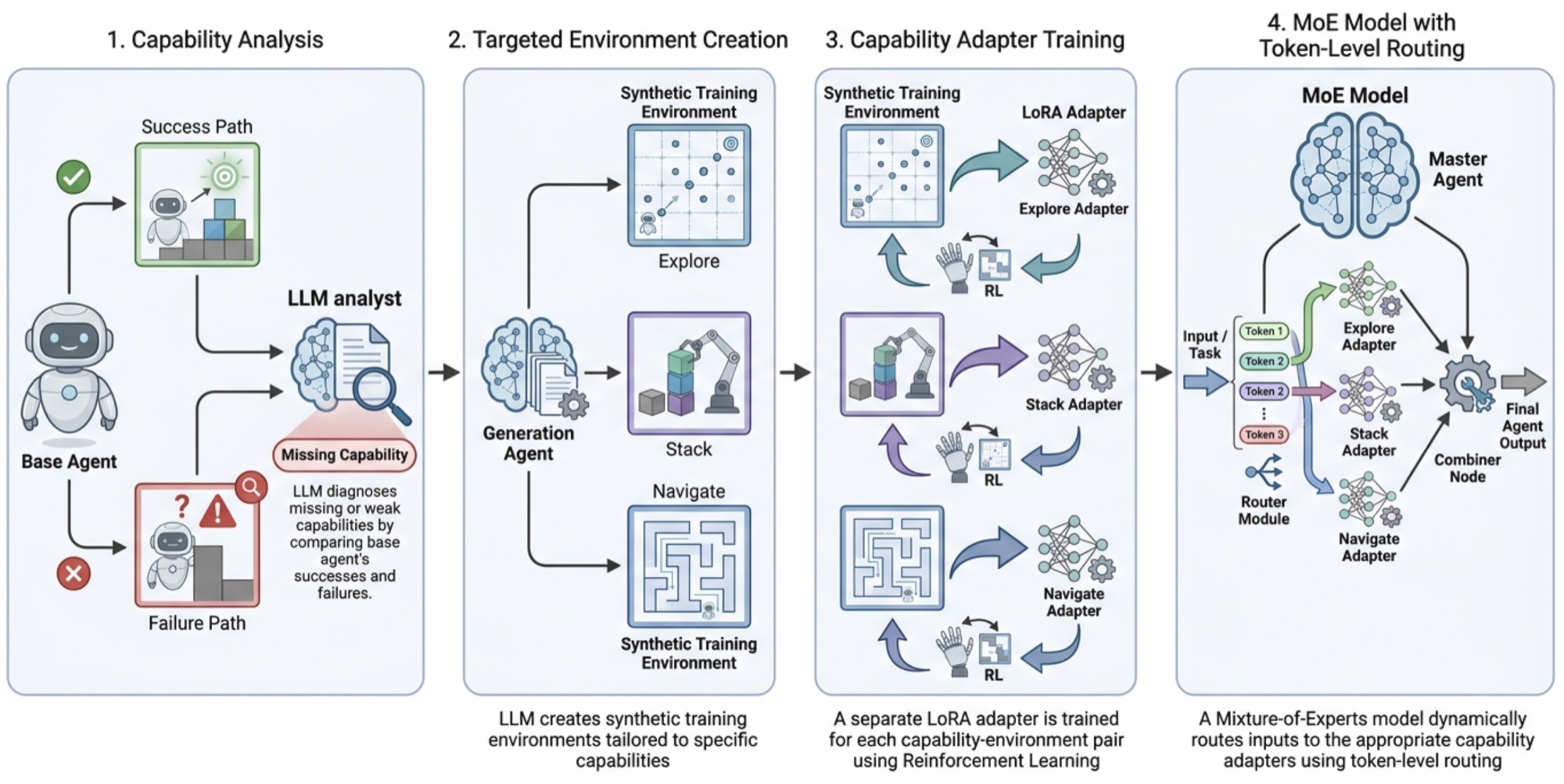
- For each missing capability, TRACE synthesizes a verifiable training environment that isolates it, trains one LoRA adapter per capability with RL, and composes the adapters with token-level MoE routing.
- On Qwen3-30B-A3B, TRACE improves τ²-Bench by +15.3 points (32.9 → 48.2) and SWE-bench Verified by +15 points Pass@1 (26.0 → 41.0) — beating the strongest external baselines by more than 8 points while using less than one-fourth the rollouts.
- On Qwen3.6-27B, TRACE reaches 73.2% Pass@1 on SWE-bench Verified — a 27B open-weight model outperforming GPT-5.2-Codex (72.8%) on the public leaderboard.
Why do agents keep failing the same way?
Agentic LLMs fail in target environments because they often lack reusable capabilities the environment demands — retrieving the right customer record before acting, verifying preconditions before a state-changing tool call, or localizing the right function in a large repository. The two mainstream fixes both spend compute poorly:
- Direct RL / SFT on the target environment gives sparse, mixed supervision: a trajectory fails as a whole, and the reward never says which underlying skill was missing.
- Broad synthetic data is untargeted: much of the budget goes to capabilities the model already has.
Our observation is that failures are not random. When we analyze rollouts from a base agent, the same small set of deficits accounts for most failed trajectories. That makes failures actionable: instead of training on the whole environment, we can turn each recurring deficit into its own dense, verifiable training signal.
TRACE in one figure
Step 1 — Find the missing capabilities by contrast, not by guessing
We collect rollouts of the base agent in the target environment and split them into successful (𝒟⁺) and failed (𝒟⁻) sets. An analysis agent reads tool calls, observations, and final responses to induce a canonical capability dictionary, then labels every trajectory–capability pair as NA, PRESENT, or LACKING. A capability c is retained only if its absence is concentrated in failures and it explains enough of them:
Δ̂(c) = ÊR⁻(c) − ÊR⁺(c) ≥ 0.20
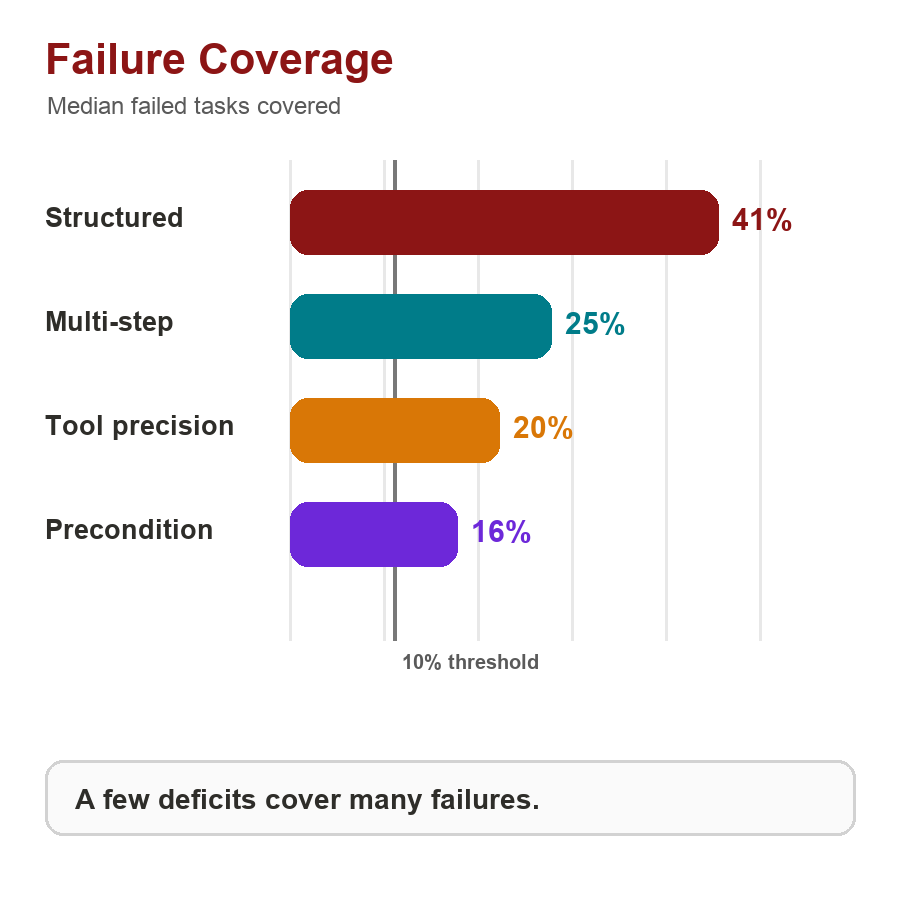
Ĉov(c) = #{failed trajectories lacking c} ⁄ #{failed trajectories} ≥ 0.10
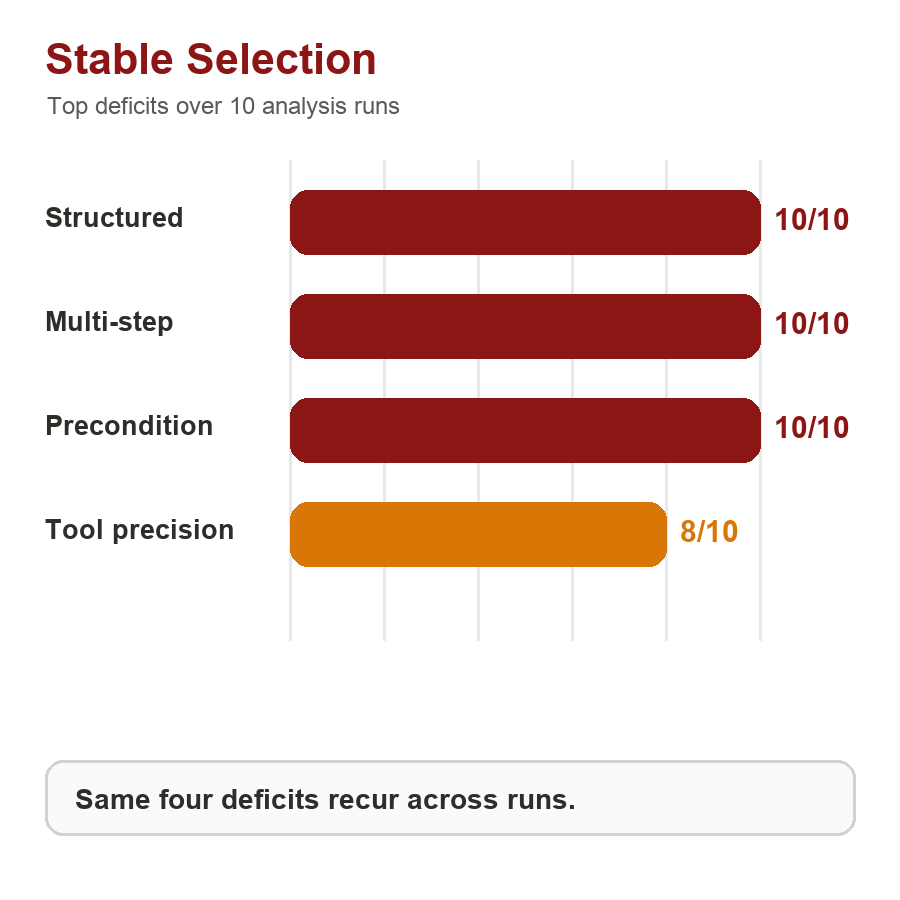
where ÊR±(c) is the rate at which c is lacking among failed / successful trajectories. On τ²-Bench this yields four deficits: structured data reasoning, multi-step task completion, precondition verification, and tool-calling precision.
Step 2 — Synthesize a verifiable environment per capability
For each retained capability, an LLM generation agent creates a seeded, procedurally-generated synthetic environment that isolates that capability while preserving the target environment's tool schemas and interaction format. Because each task instance is generated from a seed, rewards are automatically verifiable from tool arguments, state changes, final answers, or patches — no human labels, and no LLM judge in the reward loop. The result is a much denser learning signal than the original environment, where success depends on many capabilities at once.
Step 3 — Train one LoRA adapter per capability with GRPO
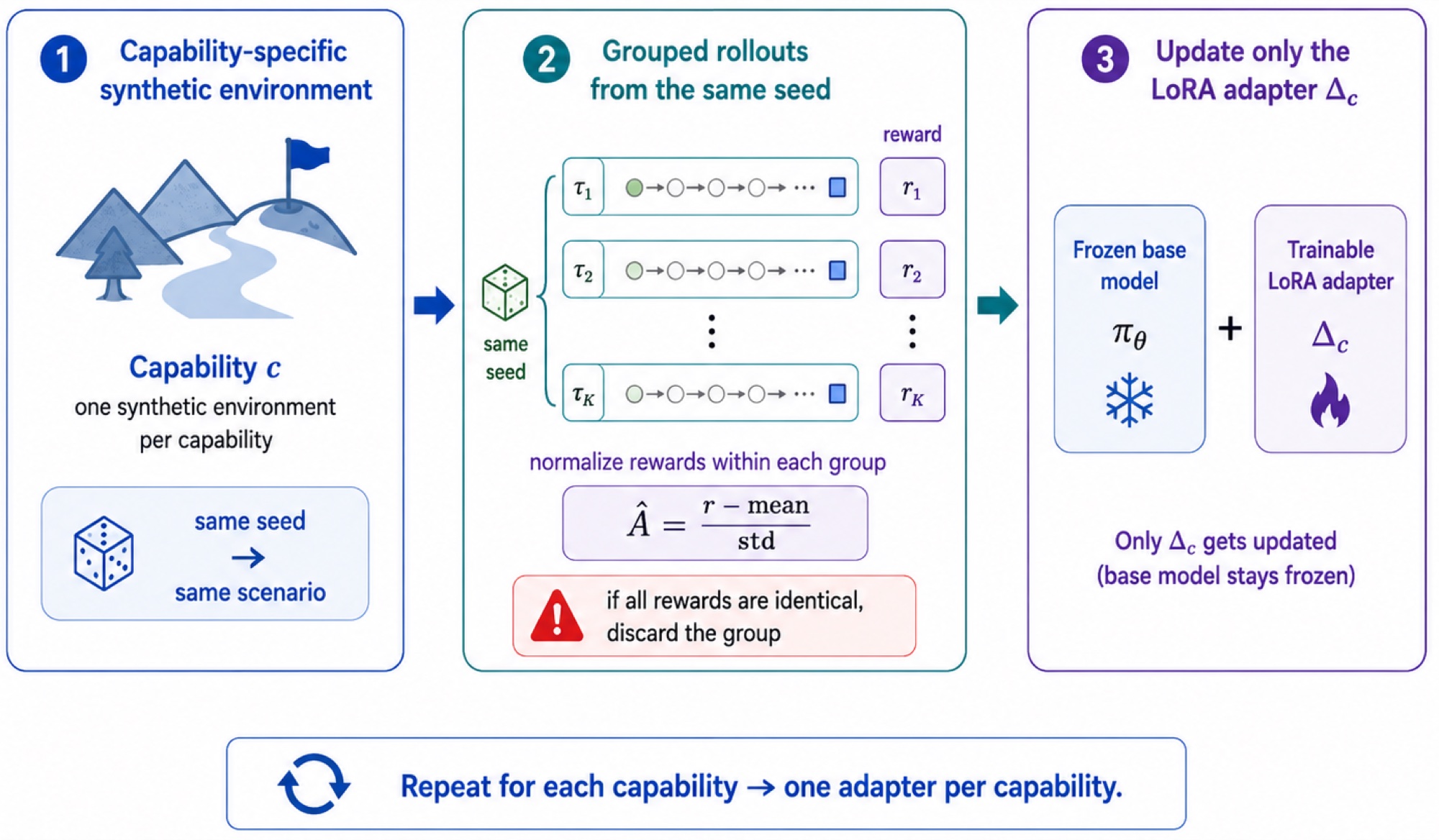
Each capability gets its own frozen-base LoRA adapter (≈5% of backbone parameters) trained with GRPO on its synthetic environment. Keeping adapters separate matters: it avoids collapsing several capabilities into one entangled update, and it gives us interpretable experts we can compose — or inspect — later.
Step 4 — Compose the adapters with token-level MoE routing
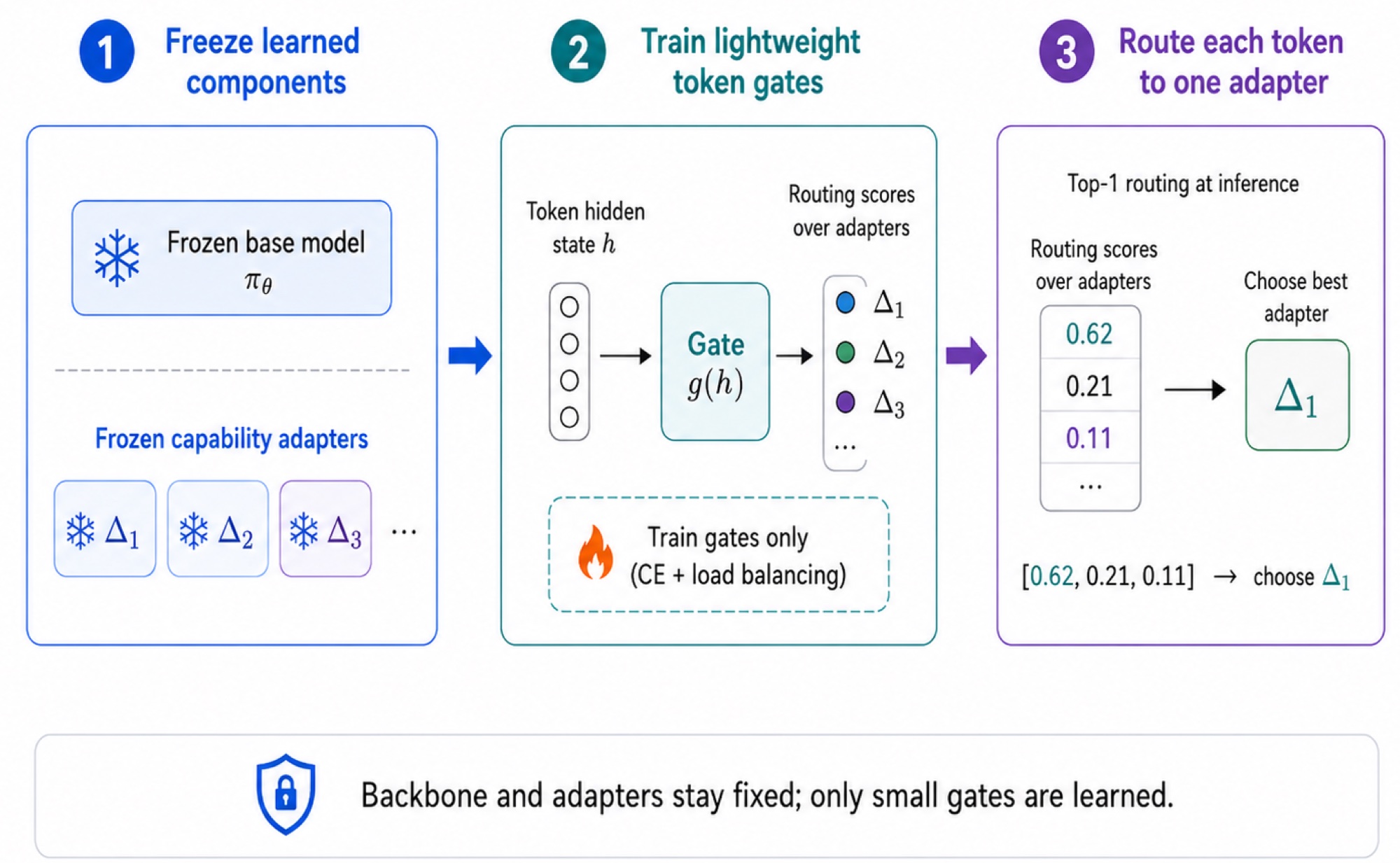
A real task interleaves capabilities — a customer-service agent reads structured data, then verifies a precondition, then issues a precise tool call, all in one trajectory. Token-level routing lets the model switch experts mid-trajectory. Top-1 routing works best on τ²-Bench: 48.2% vs. 47.0% for top-2 and 45.1% for top-4.
Main results
We evaluate on τ²-Bench (50 airline + 114 retail customer-service workflows, pass rate) and SWE-bench Verified (500 real GitHub issues, Pass@1), with Qwen3-30B-A3B-Instruct-2507 and Qwen3.6-27B backbones. Baselines include GRPO directly on the target environment, AWM, ADP, GEPA prompt optimization, and SWE-RL. For SWE-bench, TRACE's capability environments are trained on a disjoint SWE-smith split.
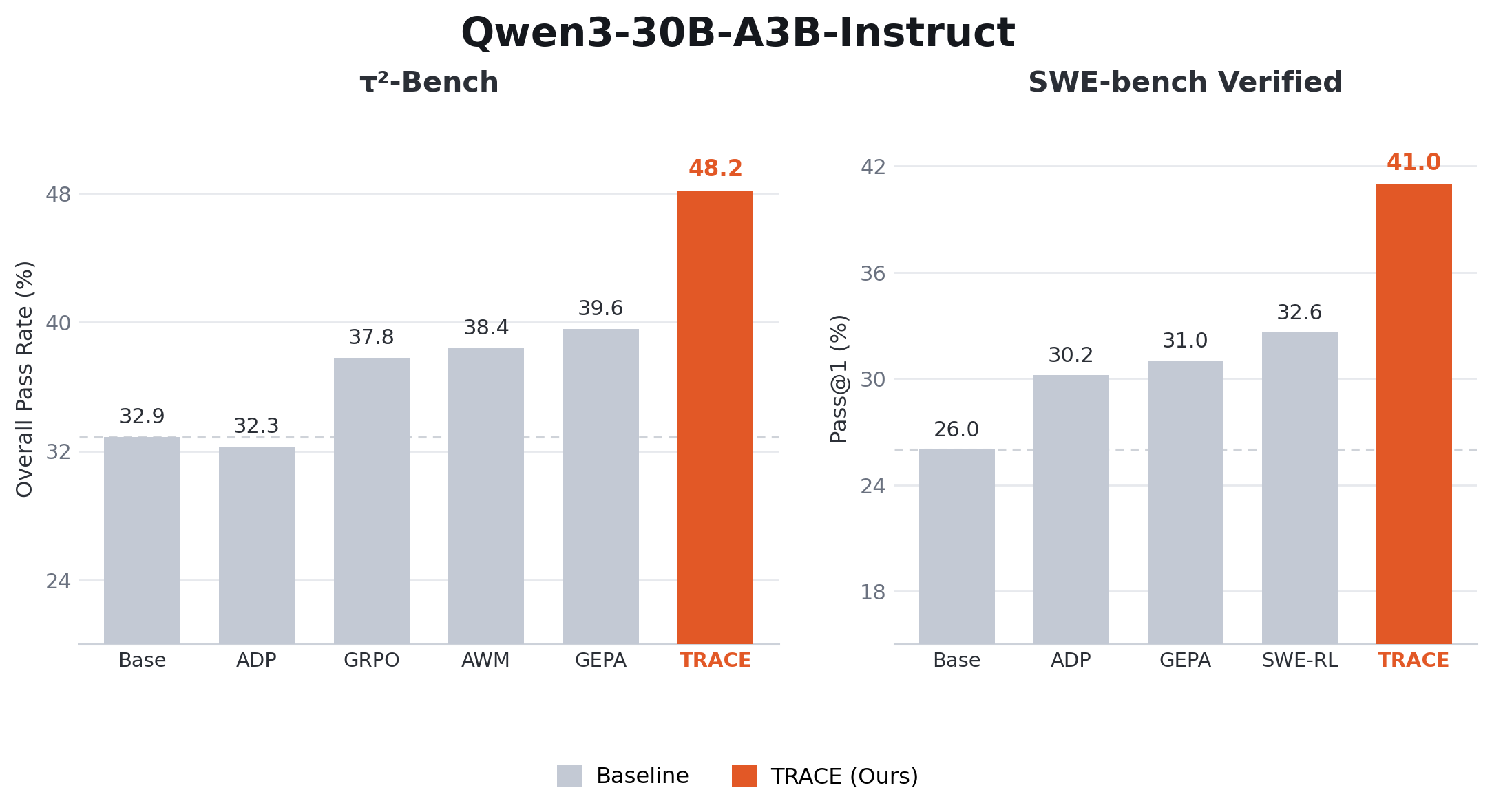
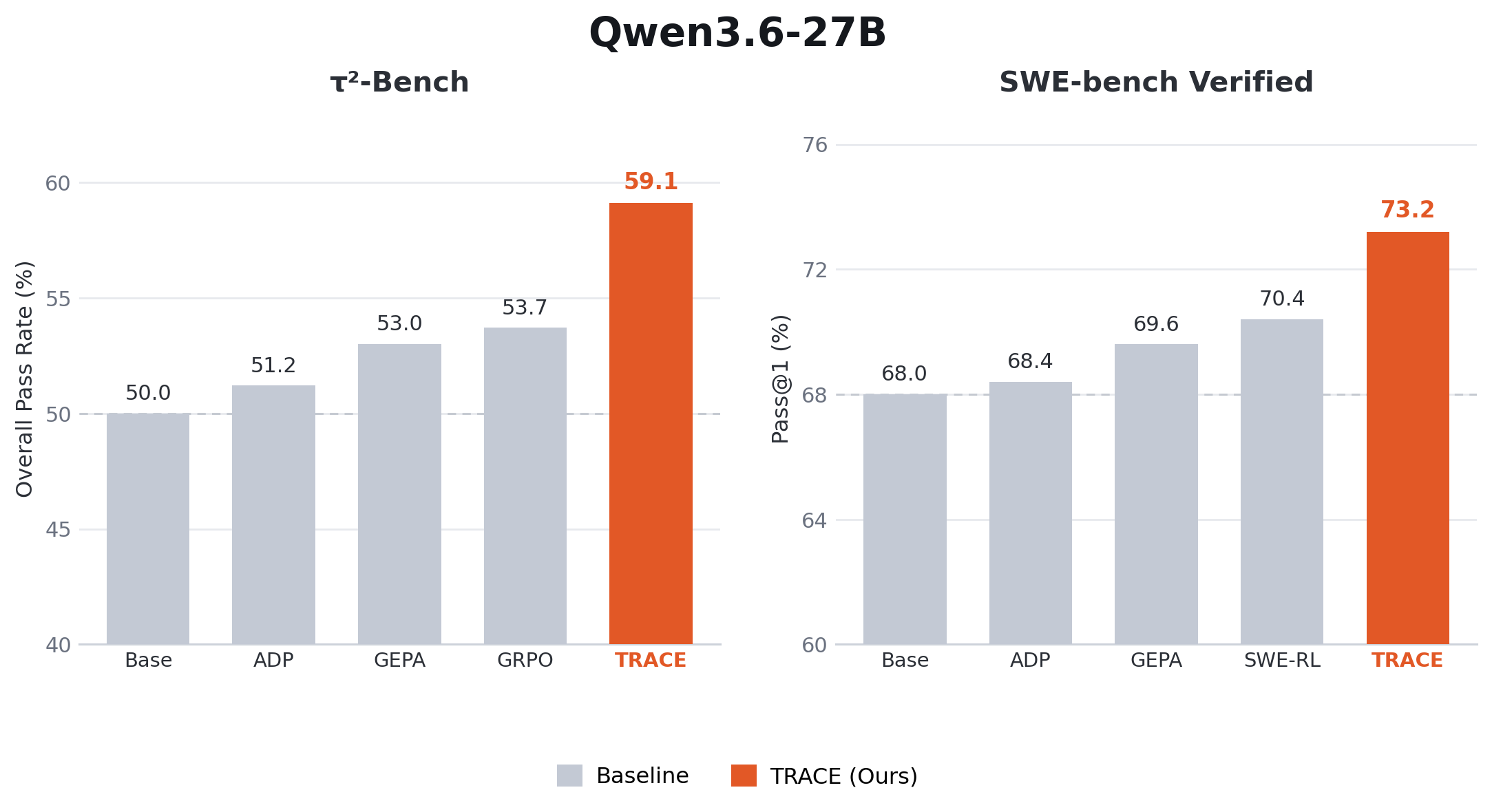
The Qwen3.6-27B result is worth dwelling on. TRACE lifts a 27B open-weight backbone from 68.0% to 73.2% Pass@1 on SWE-bench Verified — which places it above GPT-5.2-Codex (72.8%), GLM 5, and Claude 4.5 Sonnet on the public leaderboard. No frontier-scale pretraining, no proprietary scaffold: the gap is closed purely by diagnosing what the model can't do and training exactly those capabilities.
| Backbone | Method | τ²-Bench Overall | SWE-bench Verified Pass@1 |
|---|---|---|---|
| Qwen3-30B-A3B | Base | 32.9 | 26.0 |
| GEPA | 39.6 | 31.0 | |
| Strongest ext. baseline | 39.6 | 32.6 | |
| TRACE (Ours) | 48.2 | 41.0 | |
| Qwen3.6-27B | Base | 50.0 | 68.0 |
| GEPA | 53.0 | 69.6 | |
| Strongest ext. baseline | 53.7 | 70.4 | |
| TRACE (Ours) | 59.1 | 73.2 |
Capabilities scale; prompts plateau
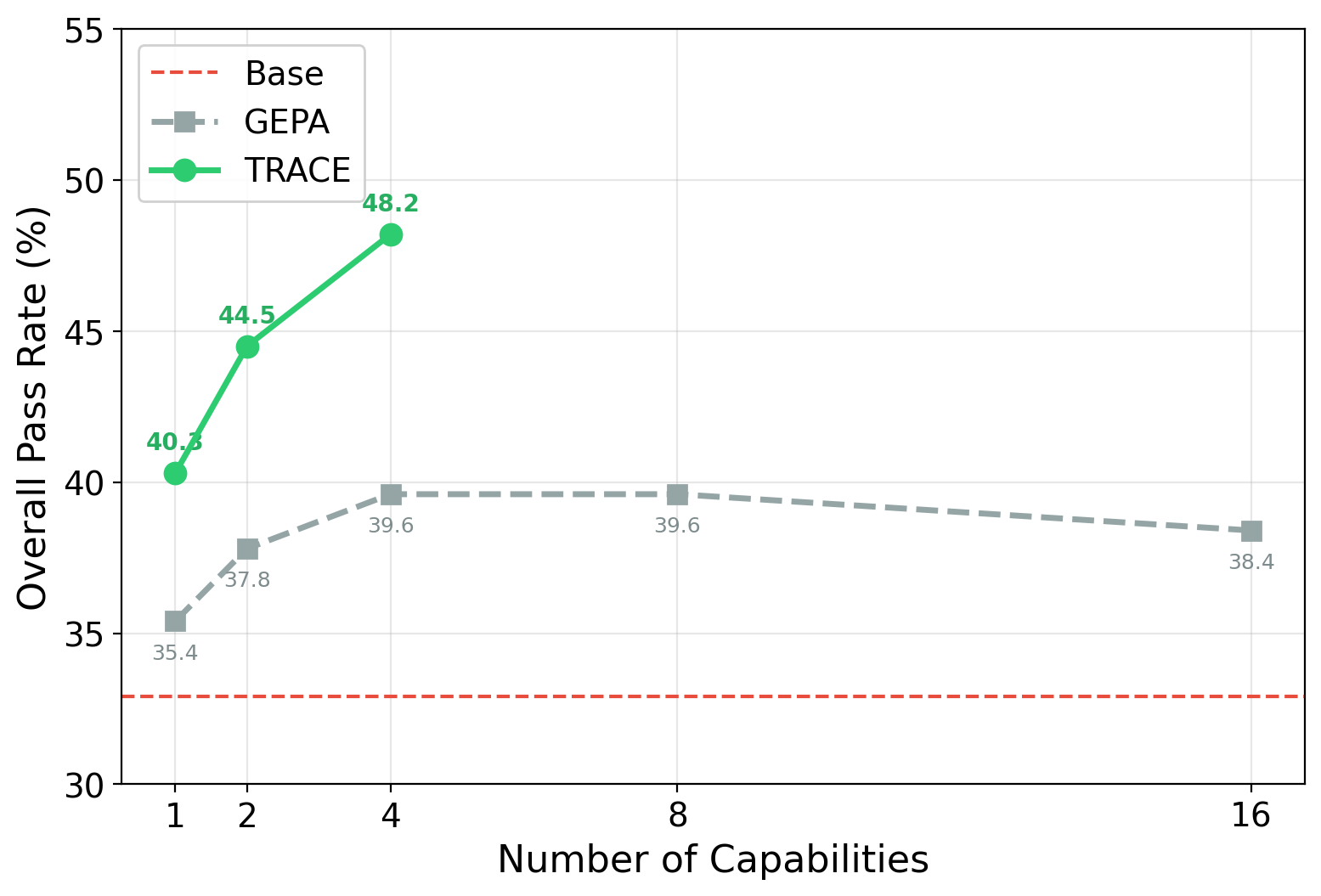
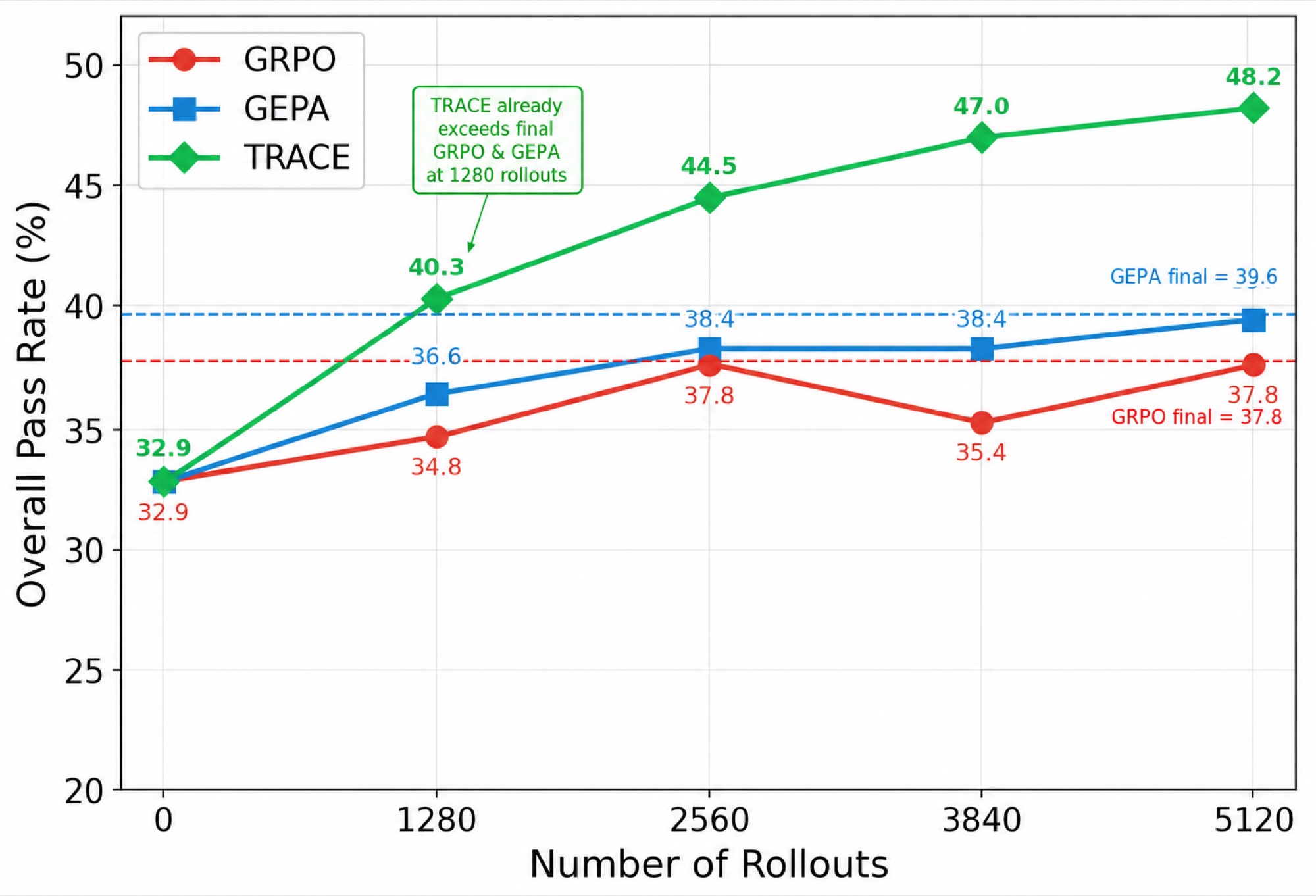
Two things stand out. First, training beats telling: GEPA can describe the missing capabilities in the prompt, and it helps (+6.7 points), but a single trained capability adapter already exceeds general-purpose AWM and ADP, and four trained capabilities beat the best prompt by +8.6 points. Second, targeted environments are sample-efficient: because each synthetic environment rewards exactly one capability, every rollout carries signal about the deficit it was built for, instead of diluting credit across the whole task.
Why composition matters
| Consolidation method | τ²-Bench Overall |
|---|---|
| SFT on synthetic data | 37.8 |
| Single-capability GRPO | 40.3 |
| Multi-capability GRPO (one adapter for all) | 40.9 |
| TRACE MoE (Ours) | 48.2 |
Given the same synthetic environments, how you consolidate the learning matters as much as the data itself. Distilling everything into one adapter — whether by SFT or by multi-capability GRPO — collapses distinct skills into a single entangled update and leaves more than 7 points on the table. Separate experts plus a learned token-level router preserves each capability and deploys the right one at the right step.
Takeaways
T1 — Failure contrast is actionable. Comparing success and failure trajectories identifies trainable deficits, not generic error categories. The diagnosis is stable across analysis runs, and a handful of deficits covers most failures.
T2 — Targeted synthetic environments are efficient. A verifiable environment built around one capability provides far denser supervision than the sparse end-task reward — TRACE outperforms target-environment GRPO and GEPA with less than a quarter of their rollouts.
T3 — Compositional adaptation matters. One LoRA expert per capability avoids collapsing multiple skills into one update, and token-level MoE routing selects the right expert at each step — worth +7.3 points over the best single-adapter alternative.
More broadly, TRACE is a recipe for environment-specific agent self-improvement: deploy an agent, watch where it recurrently fails, and convert those failures into exactly the training signal that fixes them — no human curation of skills, environments, or rewards in the loop.
Citation
@article{kang2026trace,
  title   = {TRACE: Capability-Targeted Agentic Training},
  author  = {Kang, Hangoo and Suresh, Tarun and Saad-Falcon, Jon and Mirhoseini, Azalia},
  journal = {arXiv preprint arXiv:2604.05336},
  year    = {2026}
}